
NANA was born on a rainy spring morning in Busan, in a small apartment just three blocks from the shoreline. Her mother always said the tide came in stronger that day, as if the sea itself had sensed that someone different had arrived. Growing up in a coastal city where everything moved—waves, ships, people chasing something more—NANA was a still current. Observant. Quiet, but not shy. Her eyes always wandered toward the sky, the ocean, or the dance of light on glass. She saw stories where others saw routine.
Her father, a fisherman, left early and came home late. Her mother, a former singer, worked at a hanok-style café tucked behind Gwangalli’s busy promenade. NANA often sat behind the café window after school, watching tourists sip coffee as the sun dipped below the Gwangandaegyo Bridge. She began sketching them—first in notebooks, then with watercolors, then with a cheap tablet her uncle gave her when she turned sixteen.
She left Busan briefly to study visual communication in Seoul, where she learned the power of storytelling through image and product. But something always felt missing. In group critiques, she spoke often of texture, of honesty, of salt in the air and the pink light at 6:47 PM in late September—things most of her peers dismissed as too poetic. But for NANA, those were the only things that mattered.
After graduation, when everyone else sought agency jobs in Gangnam or overseas contracts in Singapore, NANA quietly packed her things and took the KTX back to Busan. She didn’t have a plan. Just a notebook, a love for her city, and a dream of creating something that felt like home.

That’s when she met GAHSS’NA.
She stumbled across a small tasting event in a local concept store in Seomyeon—just a few bottles on a shelf, wrapped in a hot pink label with bold, cheeky lettering that read “GAHSS’NA.” At first, she laughed. The name felt familiar, like an inside joke only Busan people would get. She took a sip. It sparkled—not just from the bubbles, but from the boldness of it. It wasn’t sweet in a lazy way. It had layers. Confidence. A wink. A memory.
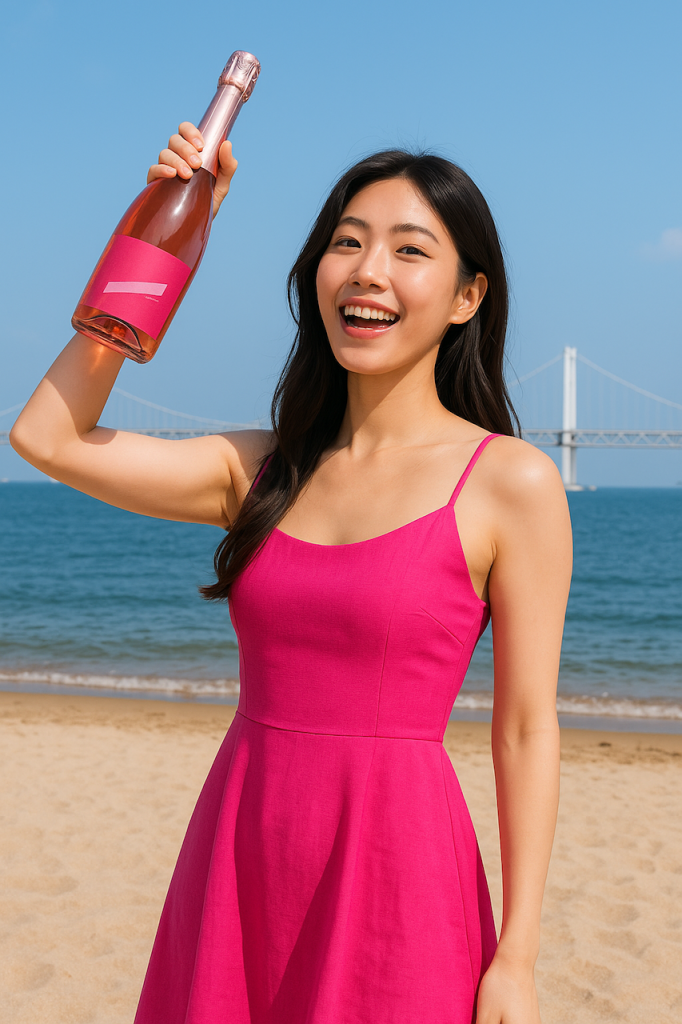
She contacted the brand. She told them their wine made her feel like Busan was speaking in a new language—one the world needed to hear. They invited her to collaborate. Not just as a model, but as a creative muse. She became the face of the brand—but not just a face. She designed the mood boards, helped shape the pop-up experience, and directed the first photoshoot at Gwangalli, where she stood barefoot in the sand, holding the bottle like a lighthouse.
Then came Atlanta. The World Korean Business Convention. Her first international trip. She walked into the convention center wearing a hanbok-inspired blazer she designed herself and watched as GAHSS’NA—her GAHSS’NA—sold out in two days. Buyers from Canada, Uzbekistan, and Texas asked who made the brand. She stood there, smiling, bottle in hand, and said, “Busan did.”
Now, NANA is no longer just a local artist. She’s a symbol. A storyteller. A bridge between cultures, between tradition and innovation. The sparkle in GAHSS’NA is hers, just as much as it’s the city’s.
She still walks the beach at sunset sometimes, the bottle by her side, not to sell it—but to feel it.
The sea. The story. The spirit.


